
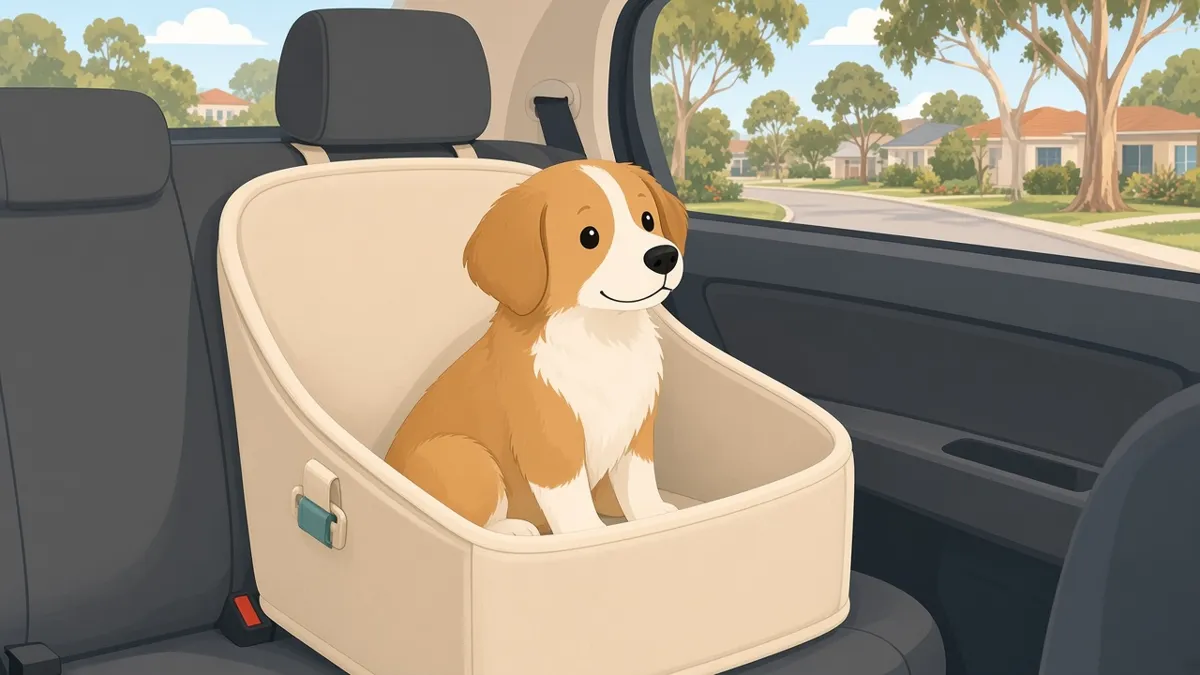
A booster seat raises a small dog, keeps it in one spot and, with a tether clipped to a harness, stops it roaming around the car. We are not recommending either seat below as crash protection. Rules about restraining dogs in vehicles vary between Australian states and territories, so check your state or territory road authority. This guide is general information, not legal or veterinary advice.
This page contains affiliate links. We earn a commission if you buy through links on this page, at no extra cost to you. As an Amazon Associate I earn from qualifying purchases.
Quick pick
- Lower-friction first purchase: the Amazon Basics bucket seat in the first card below, with a higher listed weight limit.
- More features, with a trade-off: the K&H bucket booster in the second card. It has two tethers and a washable cover, but a lower weight limit than the Amazon Basics seat, so check it against your dog.
Car travel basics
A booster seat is a place for your dog to sit. It is not the same thing as a crash-tested restraint. RSPCA Australia's Knowledgebase says there is no formally recognised Australian standard for crash testing dog car restraints, and that product claims vary, so you need to check any claim yourself. It also says it is not legal advice. You can read it at Do I need to restrain my dog when travelling in my car?
- Rules vary by state and territory. Check your road authority. Two starting points are the WA Road Safety Commission page on mobile phones and distractions and the Transport WA page on vehicle safety and standards.
- Use a harness, not a collar, for any tether. See our harness guide, which is about walking harnesses, and we do not say any harness in it is made for car use.
- The back seat is usually the practical spot. Check your vehicle handbook about airbags before you put a dog in the front.
- Never leave a dog in a parked car. The RSPCA heatstroke page says never leave a dog in a vehicle. See also our cooling mat guide.
- Keep your dog out of the driver's lap. A dog on your lap is a distraction, and rules vary by state and territory.
Comparison: ways to travel with a small dog
This table compares the general options, not individual products.
| Option | What it does | What to check |
|---|---|---|
| Booster or bucket seat with tether | Raises the dog for a view, keeps it in one place, and the tether clips to a harness | Weight limit and interior size, how it attaches (seat belt or headrest), and whether the maker says anything about crash performance |
| Car harness (seat belt harness) | Connects the dog's own harness to the car seat belt | Fit against chest measurements, any stated testing and who did it, and the size chart. A walking harness is not the same thing |
| Crate or carrier fixed in the car | Contains the dog, and can be belted or wedged in | Crate size against the dog and the car, airflow, and how the crate is fixed. See our crate guide |
| Seat cover or hammock | Covers the upholstery and stops falls into the footwell | It does not restrain the dog on its own |
Simple shortlist
Amazon Basics Pet Car Booster Bucket Seat
A foam bucket-style seat that, per the listing, keeps a pet in one place, connects to the car's seat belt and includes an adjustable lead to clip to a pet harness.
Caveat: The listing gives a maximum weight recommendation of 15 kg, but the interior is only 34 x 34 x 27 cm, so measure your dog sitting and lying down. The listing says it does not connect to a headrest. It is hand wash only. We found no crash-test or certification information on the listing, so we do not say how it performs in a crash.
K&H Bucket Booster Pet Seat, Small
A collapsible bucket booster with two tethers and a removable, machine-washable quilted fleece cover. The listing also states a 1-year limited manufacturer warranty.
Caveat: When we checked on 10 November 2026, the listing gave a maximum weight recommendation of 20 pounds (about 9 kg) for the Small. An earlier version of the listing said 15 pounds, so check the figure on the page against your dog's weight. The listing states: "This is not a crash safety device but will provide you with distraction free driving." It is sold by a third-party seller, not Amazon.
Pros and cons of a booster seat
Pros
- Raises a small dog so it can see out
- Keeps a dog in one spot instead of roaming the car
- A tether can clip to a harness
- Collapsible or hand-washable designs are easy to store and clean
Cons
- A booster is not the same as a crash-tested restraint
- Weight limits can rule out many small dogs
- Interior size may be smaller than the outside dimensions suggest
- Not every dog will sit in one, and chewers can damage straps and covers
Fitting tips
- Check the limits. Compare your dog's weight with the weight limit, and measure your dog sitting and lying down against the interior size.
- Use a harness. Clip the tether to a harness, not to a walking collar.
- Follow the listing. Run the vehicle seat belt through the seat the way the maker describes, and check the seat does not move around.
- Introduce it at home first. Let your dog sit in it indoors with treats before any drive.
- Start with short trips, then check the straps.
Common mistakes
- Treating a booster as a crash device.
- Clipping the tether to a collar.
- Buying on the word "small" without checking the weight limit.
- Leaving the seat belt loose.
- Leaving a dog in a parked car.
Frequently asked questions
Can I use my walking harness as the car restraint?
Not unless that harness's maker says it is for vehicle use. Walking harnesses (including the ones in our small dog harness guide) are for leads and walks. RSPCA Australia's Knowledgebase says a harness that is safe for restraint in vehicles should have passed safety or crash tests for that purpose, and that it may be different from the harness used to walk a dog. Source: RSPCA Knowledgebase car travel page (updated 30 September 2025; read 9 November 2026). General information only, not legal advice.
Do I need to restrain my dog in the car?
Rules vary between Australian states and territories. Check your state or territory road authority, and read the sources linked in the basics section above. This is general information, not legal advice. RSPCA Australia still recommends restraining a dog for safety reasons even where the road rules differ.
Is a booster the same as a crash-tested harness?
No. A booster raises and positions a dog. If you want a product with stated testing, read who did the testing and to what standard, and remember that RSPCA Australia says there is no formally recognised Australian standard for crash testing dog car restraints or carriers.
What do I clip the booster tether to?
Clip it to a harness, never a collar. The harness still needs to be one the maker says suits car or tether use. Our walking harness guide is about fit and sizing for walks; it does not approve those products for the car.
What about a crate in the boot?
A crate is another option for some cars and dogs. See our crate guide. If your dog dislikes the car, our calming products guide has ideas, and your vet can advise on your own dog.
How we choose
For this guide we compared the main ways to restrain or seat a small dog in a car and read the size, weight limit, material, care and stock information on the two Amazon listings we link. We have not tested these products ourselves. We have not independently verified safety claims or crash performance for any product.
This guide is research-based. We have not hands-on tested these products. We compare manufacturer and listing specifications and general guidance, and any pros, cons and picks are the Small Paw Guide editorial team's own assessment, not test results. We do not show prices or customer feedback, so check the current listing before you buy. See how we work and our affiliate disclosure. The review date for this guide is shown under its title.
Final thought
Choose on the weight limit and interior size first, use a harness for any tether, and treat a booster as a way to seat your dog, not as crash protection.
Keep reading
- Small Dog Harness Sizing Guide for Australia: Measuring for a harness, which is what a booster tether clips to.
- Best Dog Crates for Small Dogs in Australian Apartments: A crate is another way to travel with a small dog.
- Best Calming Products for Anxious Dogs: Fireworks Night Plan: Ideas for a dog that dislikes the car.
- Puppy Essentials Checklist Australia: What to Buy First: Car gear in the wider new-puppy list.
- Best Cooling Mats for Small Dogs in Australian Summer: Heat and summer comfort at home.
More in this topic: gear and setup guides, or browse all guides.