
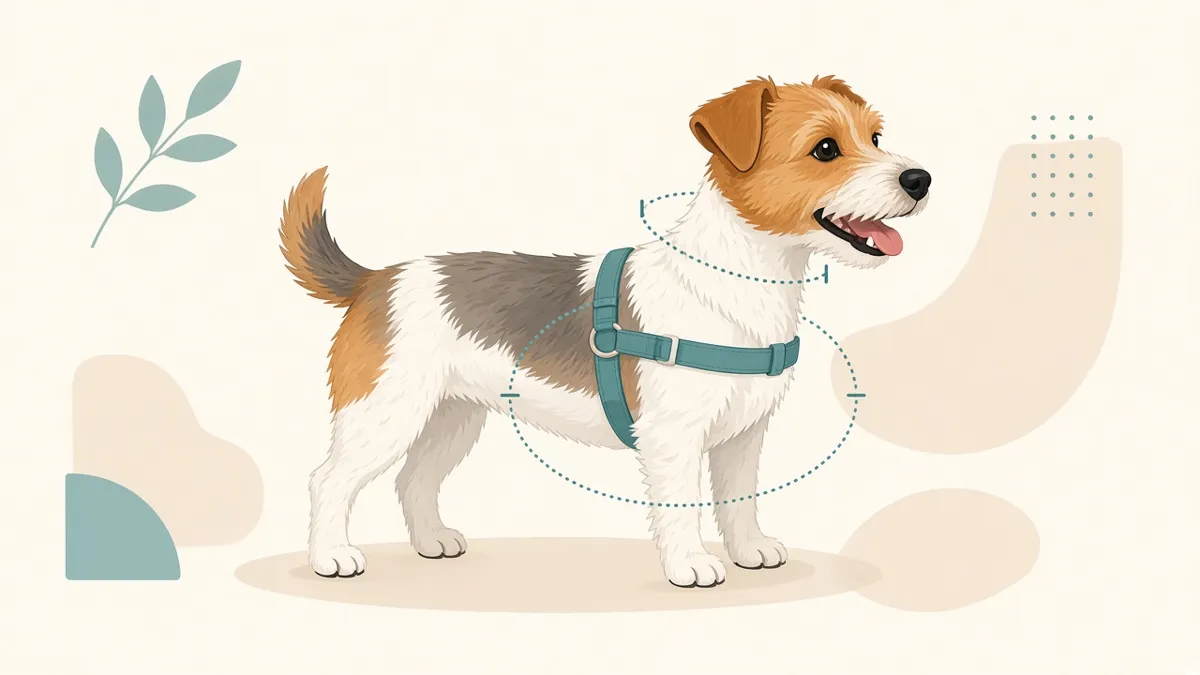
The best small dog harness is the one that fits your dog's chest, not the one with the most straps. Measure chest and neck with a soft tape, then check both numbers against the chart on the listing. A calm 3 kg Maltese usually needs nothing more than a light mesh step-in. A 7 kg Cavoodle who leans into the lead gives you more reason to look at a padded overhead harness with a front clip.
This page contains affiliate links. We earn a commission if you buy through links on this page, at no extra cost to you. As an Amazon Associate I earn from qualifying purchases.
Quick pick
- Soft, lightweight option: the Puppia Soft Mesh harness (Small, Black listing). It's a mesh vest with one adjustable chest belt, so it suits small dogs that sulk in bulky gear.
- Padded, more adjustable option: the rabbitgoo no-pull harness, with two leash clips and four adjustment straps. The button below opens the Medium listing, so pick your own size on the Amazon page.
- Before either: get the tape measure out (how to measure). Our shortlist covers the trade-offs.
The two harnesses side by side
We took these details from the two Amazon Australia listings and their size charts on 2026-10-27. Sellers do change listings, so check the page again before you buy.
| Feature | Puppia Soft Mesh (Small, Black) | rabbitgoo no-pull |
|---|---|---|
| Style | Soft mesh harness with padded interior and an adjustable chest belt | Overhead harness with padded air-mesh construction |
| Leash attachment | See the listing | Two clips: one on the back and one at the front of the chest |
| Adjustment | Adjustable chest belt | Four adjustment straps (two at the neck, two at the chest) and quick-release buckles |
| Size information on the listing | Small: chest 30 to 42 cm, neck 27 cm (listing text) | XS: chest 27.9 to 48.3 cm, neck 25.4 to 35.6 cm. S: chest 33 to 61 cm, neck 33 to 48.3 cm. M: chest 38.1 to 71.1 cm, neck 40.6 to 55.9 cm |
| Other listed features | Mesh construction, buckle closure | Top handle, reflective strips, air-mesh padding |
Look closely at the neck figures. The Puppia Small lists a single 27 cm neck, so only the chest belt adjusts. The rabbitgoo XS stretches from about 25 to 36 cm at the neck, which gives a lot more room for a dog that's thick-necked for its size.
Our small dog harness shortlist
Puppia Soft Mesh Dog Harness (Small, Black)
A light mesh harness with a padded lining and one adjustable chest belt. Worth a look if your small dog stiffens up the moment anything chunky goes over its head.
Caveat: The listing gives Small as roughly 30 to 42 cm around the chest and 27 cm at the neck, so measure before you order. With only the chest belt to adjust, a dog that sits between sizes has less leeway than with the padded option. We have not verified how it holds up in use.
rabbitgoo Dog Harness, No Pull, 2 Leash Clips
A padded overhead harness with clips on the back and chest, plus four straps you can adjust. Those extra straps are what help on a deep-chested Dachshund or a narrow Whippet cross.
Caveat: The button opens the Medium listing. For most small dogs you'll want XS or S, so check the size chart on the Amazon page. A no-pull harness won't teach loose-lead walking on its own, and we have not verified the fit on any particular dog.
Pros and cons of each style
Pros
- Soft mesh style: very little to it, which suits toy breeds that hate fuss over their head
- Padded no-pull style: four adjustment points and two leash clips, plus a top handle and reflective strips
- Both listings publish chest and neck ranges in cm you can check against your own tape measure
Cons
- Mesh style: only the chest belt adjusts, so your measurements have to land inside the range
- Padded style: more buckles to fiddle with, and the default link is the Medium variant
- Getting the size wrong is the main risk with either one, and no harness suits every body shape
How to measure for an extra small or small dog harness
- Chest: run a soft tape around the ribcage at its deepest point, just behind the elbows. It should sit flat against the body without squashing it. On a Pomeranian or a Shih Tzu in full coat, part the fluff so the tape reads the dog and not the hair.
- Neck: measure low on the neck, where it meets the shoulders. That's where a harness actually sits, and it's often a centimetre or two more than the collar spot.
- Compare: check both numbers against the chart on the listing. If one lands at the very top of a size, read what the seller says about sizing up and how much the straps can be let out.
The rabbitgoo instructions describe a two-finger check: once the harness is on, you should be able to slide two fingers under the straps. That's a fair test for any harness. Do it again after the first walk too, because straps can loosen once they've been pulled on for a while.
What to look for in a small dog harness
- A size chart in cm: chest and neck ranges, not just a letter on the tag. Two 6 kg dogs, say a Dachshund and a Pug, can be a full size apart across the chest.
- Adjustment points: extra straps help with deep or narrow chests, and they buy you time while a puppy grows.
- Padding where straps cross: thin webbing can rub just behind the front legs, so check where the padding sits.
- Quick to get on: a wriggly 2 kg Chihuahua is far easier to dress in something that clips on in a few seconds.
- Where the lead clips on: a back clip is all a calm walker needs. A front clip is worth having for a dog that pulls.
- Reflective trim: useful on dark winter mornings, or on summer evening walks after the pavement has cooled.
What to avoid
- Ordering by the size label alone. One brand's Small can be another brand's XS.
- A harness that gaps at the chest or pinches the shoulders when your dog trots.
- Leaving it on all day or while your dog is home alone. Take it off when you get back inside.
- Expecting a harness to fix pulling. Loose-lead training does that.
Choosing a puppy harness
A Cavoodle puppy can go from a few kilos to 7 or 8 kg within months, so look for plenty of adjustment and re-measure every few weeks. Expect to buy at least one bigger size along the way. Write down each measurement and the date. Next time you order, you can compare the numbers against the chart instead of guessing.
Frequently asked questions
Is a harness better than a collar for a small dog?
Plenty of owners of toy breeds go with a harness because the pressure lands on the chest instead of the throat. If your dog has a health condition, such as a windpipe or neck problem, ask your vet which is right.
Which size should I choose on the rabbitgoo listing?
The default link opens the Medium listing. Check your dog's chest and neck measurements against the size chart on the Amazon page, then choose XS, S or M from there.
Can I use a walking harness in the car?
Not as the car restraint. This guide covers walking harnesses for leads and everyday walks. RSPCA Australia's Knowledgebase says a harness that is safe for restraint in vehicles should have passed safety or crash tests for that purpose, and that it may be different from the harness used to walk a dog. We do not say Puppia Soft Mesh or rabbitgoo (or any walking harness on this page) is made for car travel.
For seating and travel options, see our car seat and travel booster guide. Always check the maker's own information for any product you use in the car.
Why isn't a walking harness enough in the car?
A walking harness is built for lead pressure on walks. A car restraint has to cope with sudden braking and a collision load, and attach to the vehicle the way the maker directs (usually a seat belt or buckle). RSPCA Australia notes that many products on the market have not passed any safety or crash testing, and that those may not prevent injuries in accidents. Clip a walking harness to a seat belt only if that product's maker says it is for vehicle use.
Source: RSPCA Knowledgebase, "Do I need to restrain my dog when travelling in my car?" (page updated 30 September 2025; read 9 November 2026). That page is general information, not legal advice.
What should I use in the car instead?
Common options are a vehicle-rated restraint or car harness that the maker says is for car use, a booster or bucket seat with a tether clipped to a suitable harness, or a crate or carrier secured in the car. RSPCA Australia also mentions a cargo barrier in some wagons, with the caveat that a barrier alone may not protect the dog. Our car seat guide compares those options and links two booster starting picks. We have not crash-tested any product.
Should I clip a car tether to a collar?
No. For any tether, use a harness, not a collar, so a sudden stop does not land on the neck. That still does not make a walking harness into a car restraint. Choose a harness the product maker says is suitable for the tether or car harness you are using, and check fit the same way you would for a walk (two fingers under the straps after it is on).
Do I need a front clip?
Only if your dog pulls. A front clip changes how the dog turns when the lead tightens, but training is what teaches a loose lead.
How we choose
For harnesses we compared the published size ranges, adjustment points, leash attachments and listed features, and we favoured products whose listings explain how to size them. We did not weigh brand names or popularity.
This guide is research-based. We have not hands-on tested these products. We compare manufacturer and listing specifications and general guidance, and any pros, cons and picks are the Small Paw Guide editorial team's own assessment, not test results. We do not show prices or customer feedback, so check the current listing before you buy. See how we work and our affiliate disclosure. The review date for this guide is shown under its title.
Before you order
Get the tape measure out tonight and write down both numbers. Then check them against the chart before you click through, and recheck the fit after the first couple of walks.
Keep reading
- Puppy Essentials Checklist Australia: What to Buy First: Where a harness fits in the first-week shopping list.
- Best Puppy Toys for Chewing in Australia: Chew options for a puppy that chews harness straps and leads.
- Best Dog Crates for Small Dogs in Australian Apartments: Sizing a crate with the same measuring approach.
- Best Dog Brushes for Short-Haired Dogs in Australia: Coat care for small dogs that wear a harness daily.
- Best Car Seats and Travel Boosters for Small Dogs in Australia (and Car Travel Basics): Car seats and boosters whose tethers clip to a harness.
More in this topic: gear and setup guides, or browse all guides.